

Higher education is dynamic and rewarding, but mental health challenges are increasingly visible among students. Faculty, staff and administrators are often the first to notice changes in a student’s behavior, mood or academic performance. However, many feel unprepared to respond confidently and compassionately. Fortunately, Mental Health First Aid (MHFA) offers a practical way to bridge that gap.
https://mentalhealthfirstaid.org/individuals/higher-education/
What is Mental Health First Aid?
Mental Health First Aid is an evidence-based program that teaches individuals how to identify and respond to signs of mental health and substance-use challenges. Similar to CPR for physical health emergencies, MHFA equips people with skills to offer support, encourage professional help and recognize when immediate intervention is needed.
https://mentalhealthfirstaid.org/
Why MHFA is important in higher education
- Students are facing higher rates of stress and mental health challenges
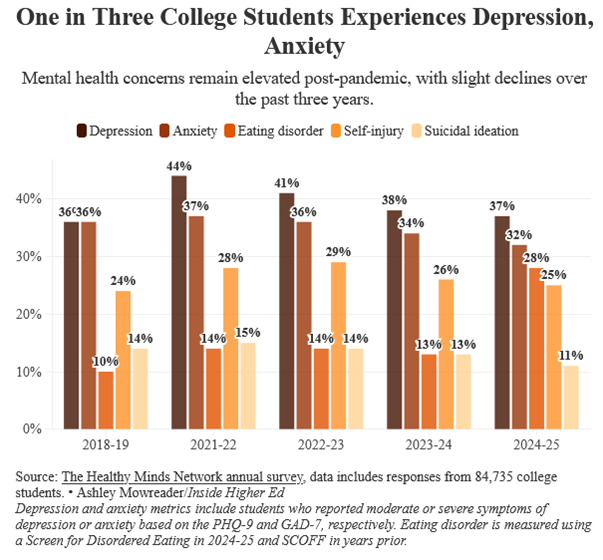
Academic pressure, financial stress, identity development, and life transitions all occur in college. Research shows that individuals aged 18-25 have the highest prevalence of mental health concerns (Acad Psychiatry, 2015). Moreover, recent national data shows that while mental health indicators are improving, 37% of college students still report moderate to severe depressive symptoms and 32% experience moderate to severe anxiety (Healthy Minds Network, 2024), making early identification crucial for Illinois campuses.
https://www.insidehighered.com/news/student-success/health-wellness/2025/09/11/college-student-mental-health-remains-poor-minority Graph resource
SAMHSA. (2023). Key Substance Use and Mental Health Indicators in the United States: Results from the 2022 National Survey on Drug Use and Health.
https://www.samhsa.gov/data/report/2022-nsduh-annual-national-report
- Faculty and staff are often the first to notice
Professors may observe declines in attendance or academic performance. Advisors may hear concerns during student interactions. Residential life staff often notice behavioral shifts in students living away from home. MHFA empowers these and other higher education professionals to recognize changes early, ask difficult questions safely and provide appropriate guidance.
https://www.apa.org/monitor/2022/10/mental-health-campus-care
- It builds a culture of care on campus
A mentally healthy campus requires commitment from everyone. MHFA-trained staff contribute to a supportive environment where students feel seen, supported and connected—improving both academic success and overall campus well-being.
https://www.linkedin.com/pulse/creating-culture-belonging-college-campuses-keys-student-banks-bk3lc/
- MHFA reduces stigma
Stigma remains one of the biggest barriers to seeking help. When higher education professionals talk openly and respectfully about mental health, it normalizes these conversations. As stigma decreases, students are more likely to seek support when they need it.
Skills gained through MHFA training
- Recognize signs and symptoms of mental health or substance-use challenges
- Engage in supportive, non-judgmental conversations
- Assess for risk of harm or crisis
- Connect individuals to appropriate campus and community resources
- Support peers and colleagues
How the ICC TAC supports mental health on college campuses
The Mental Health Early Action on Campus Act (MHEAC, 110 ILCS 58) took effect July 1, 2020, to address gaps in mental health services on Illinois college campuses through training, peer support and community-campus partnerships.
The Illinois Campus Cares Technical Assistance Center (ICC TAC) operates under the MHEAC Act, in collaboration with the Illinois Board of Higher Education (IBHE) and Illinois Community College Board (ICCB) to support mental health services at public institutions. Funded by the State of Illinois and administered by IBHE, the ICC TAC raises awareness, provides training and offers resources to help colleges better serve students’ mental health needs.
To address service gaps, the ICC TAC offers free MHFA training to higher education professionals at public universities and colleges across Illinois. These trainings equip faculty, staff, advisors, campus police and others with evidence-based skills to recognize struggling students and take appropriate action.
Trainings are scheduled for 2026 and are free to attend.
If you’re interested in MHFA training, submit a form at: https://app.smartsheet.com/b/form/fa059fd2e3714b3c936229316a877f30
In an environment where well-being directly influences student success, MHFA is a meaningful investment. The ICC TAC is proud to offer these trainings at no cost to Illinois higher education professionals in 2026.
 Taylor Blakeley, PhD, CRSS, Co-author
Dr. Blakeley is an assistant professor in the Dept. of Psychiatry at SIU School of Medicine, project manager with the Illinois Behavioral Health Workforce Center, and adjunct professor at Purdue University Global. He holds a Ph.D. and Master’s in Industrial/Organizational Psychology from Liberty University, graduating with highest honors, and a Bachelor’s in Psychology from Benedictine University. He is a Certified Recovery Support Specialist and former clinical supervisor in behavioral health and correctional institutions. Dr. Blakely teaches Mental Health First Aid to various populations and is an advocate for developmentally disabled individuals seeking employment.
 Kyle Fontaine, MBA, MSc, BSc, BEd, Co-author
Kyle works for both the Illinois Campus Cares Technical Assistance Center and the Illinois Behavioral Health Workforce Center at SIU School of Medicine. Before stepping into this role, Kyle was a high school teacher supporting young adults who thrived in nontraditional learning environments. His passion for creating inclusive, supportive spaces carries into his current work. As a certified Mental Health First Aid Instructor, Kyle partners with colleagues to break down the stigma around behavioral health, empowering others to listen, offer support and respond confidently when someone is struggling.